

Fractional CRO
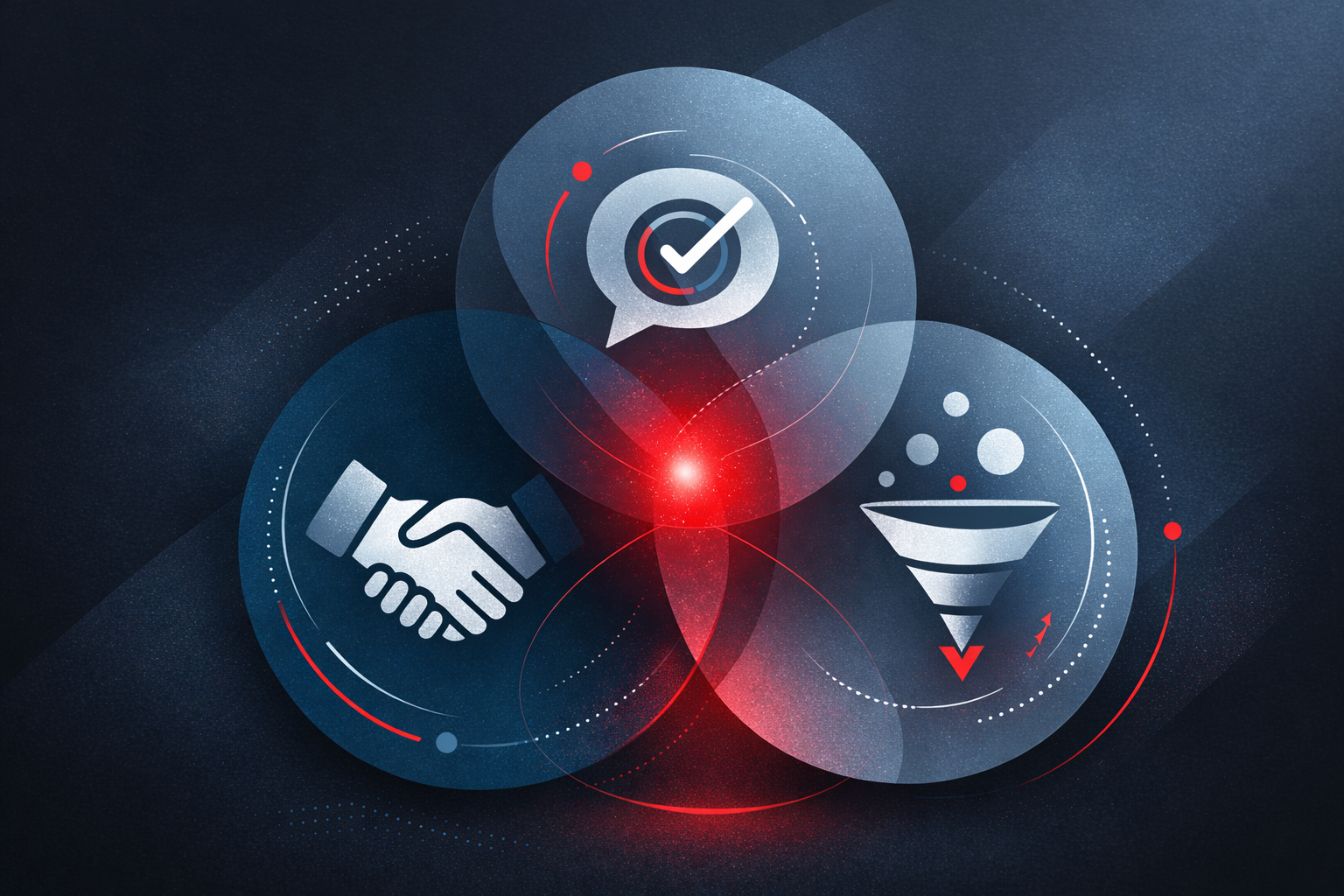

ABM alignment is the operational state in which Sales, Product Marketing, and Demand Generation share the same account intelligence, the same narrative, and the same definition of what a sales-ready account looks like. Without it, account-based marketing produces activity (impressions, meetings, sequences) but not the predictable revenue everyone wants.
Most B2B teams discover this gap the hard way. Despite a live seemingly text book ABM playbook, enterprise deals are still stalling. The instinct is to blame the tool or the list. The actual cause is almost always a breakdown in cross-functional alignment. Three teams executing their individual roles correctly, but still produce a fragmented, incoherent experience for the account they're all trying to win.
At the enterprise level, incoherence is disqualifying. Buyers in complex, multi-stakeholder deals are evaluating your company's judgment and consistency as much as your product. When your ad, your outreach, and your sales conversation feel like they came from three different companies, the implicit message is that your internal teams don't talk to each other, and that's not a company they want to build a long-term relationship with.
ABM fails to generate pipeline for three structural reasons, each tied to a specific team alignment breakdown.
Root Cause 1: Narrative fragmentation. When Product Marketing is not embedded in the ABM motion from the start, demand generation and sales are both operating without a shared account narrative. The result is strategic positioning and messaging that changes depending on which team the buyer is talking to. The most common cause of stagnant pipeline growth in enterprise ABM isn't targeting or reach. It's incoherence at the message level.
Root Cause 2: Missing account intelligence. ICP development that happens inside marketing without Sales feedback produces an ideal customer profile based on firmographic patterns rather than lived deal intelligence. Sales knows which stakeholders are actually in the room, what internal objections are forming, and what the champion needs to say to get the deal through procurement. When that intelligence doesn't flow upstream into content and campaign decisions, ABM plays to a buyer that doesn't exist.
Root Cause 3: A broken feedback loop. Multi-channel demand generation produces a constant stream of behavioral signals.
Content engagement
Ad interaction
Email response patterns
Intent spikes.
When Demand Gen doesn't translate those signals back into the account strategy in real time, pipeline velocity tracking becomes a lagging indicator of a problem that compounded over weeks. The team keeps running the same play to an account that has already moved on to a different question.
Fixing B2B sales and marketing alignment in an ABM motion requires establishing clear ownership across three functions, then building a shared operating rhythm that keeps those functions synchronized as accounts develop.
Product Marketing owns the account narrative. This means strategic positioning and messaging is built at the account level, not just the segment level, and is the foundation that sales conversations, ad creative, and content all draw from. Product Marketing should be involved in defining why a specific account should care, what language resonates with buyers versus technical evaluators, and how to frame ROI in a way that arms the internal champion to sell upward.
Sales owns the account intelligence. This means ICP development is an ongoing conversation with Sales, not a one-time research exercise. The sales team's knowledge of stakeholder dynamics, internal objections, and deal-stage nuance should be continuously shaping what content gets created, what plays get run, and how the account narrative evolves over time.
Demand Gen owns the feedback loop. This means behavioral signals from multi-channel demand generation are being interpreted and redistributed, not just reported. Account engagement data should be flowing into sales conversations and campaign decisions in near real time, so that the GTM engine is learning and adapting rather than repeating.
The sync between these three owners is not a standing meeting. It is a shared operating model. It's a common definition of account readiness, a common vocabulary for describing account movement, and a common rhythm for updating the strategy based on what the accounts are actually telling you.
A scalable GTM engine for enterprise ABM is a cross-functional operating system, not a campaign calendar. It has four defining characteristics.
Shared account definitions. Every team agrees on what a qualified, sales-ready account looks like, not based on MQL logic, but based on account-level signals including engagement depth, stakeholder mapping, and buying stage indicators.
A living narrative architecture. Strategic positioning and messaging is maintained by Product Marketing as a living document that Sales can draw from in real time and that Demand Gen uses as the brief for every campaign. It evolves as the market, the accounts, and the competitive landscape evolve.
Pipeline velocity as a team metric. Pipeline velocity tracking is owned collectively, not by Sales alone. When pipeline slows, the question isn't "why isn't Sales closing?" It's "where is the account experience breaking down, and which team's input fixes it?"
A closed-loop learning system. What's working in the field improves what's being built in the room. Demand Gen signals inform Product Marketing's messaging decisions. Sales intelligence informs Demand Gen's targeting decisions. Product Marketing's narrative evolution informs how Sales frames conversations. This is what efficient customer acquisition looks like at enterprise scale: a system that gets smarter with every account, rather than resetting at every campaign.
Enterprise ABM deals stall because the internal champion can't build a coalition, not because the vendor isn't known to the account. This is the distinction that most ABM strategies miss completely.
In enterprise buying cycles, the person who signs the contract is rarely the person who discovered your solution. The champion inside the account has to sell you internally ( to their CFO, their IT leadership, their legal team, and sometimes their board) The quality of that internal sale determines whether the deal closes, not the quality of your outreach volume.
Effective ABM enables that internal sale at every stage. It gives the champion the language their CFO will respond to, the proof points their IT team will trust, and the ROI narrative their CEO can greenlight. This level of support only happens when Sales has identified the champion and their specific internal dynamics, Product Marketing has built the right assets and language for those conversations, and Demand Gen is surfacing those assets at the right moment in the account's journey.
When any one of those conditions is missing, the champion is left to improvise, and improvised internal sales pitches lose to the status quo, not to competitors.
A company should consider a Fractional CMO for SaaS or a GTM Strategy Consultant for ABM when the motion has investment but not alignment. This is when the tools are running, the team is executing, and the enterprise deals still aren't closing at the rate the business needs.
This inflection point is common at Series A and Series B, when founder-led sales has been replaced by a go-to-market team but the cross-functional operating model hasn't been built to match the team's size. Marketing is generating activity. Sales is working accounts. Product Marketing is producing content. But the three aren't functioning as a system, which means the company is burning budget on a GTM motion that isn't compounding.
A Fractional CMO or GTM Strategy Consultant brings the revenue architecture thinking and cross-functional operating experience to diagnose where the system is breaking down and build the alignment infrastructure that makes ABM work at scale. This includes GTM Audit & Diagnostics, ICP development with Sales input, KPI frameworks for B2B marketing tied to account outcomes, and sales enablement for tech teams built on Product Marketing's narrative.
When the alignment is right, the result is a shift from stagnant pipeline growth to marketing-sourced pipeline that closes, and from high CAC to efficient customer acquisition driven by a coherent, compounding account experience.
What is the difference between ABM and demand generation? Demand generation is a broad motion designed to create awareness and capture intent across a wide audience. ABM is a targeted, account-specific strategy designed to generate pipeline and close deals within a defined set of high-value accounts. The critical distinction is that effective ABM requires cross-functional alignment between Sales, Product Marketing, and Demand Gen. It cannot be run as a marketing-only initiative and produce consistent enterprise results.
Why is my ABM not working even though I have the right tools and target list? The most common reason ABM underperforms despite the right tooling is a breakdown in B2B sales and marketing alignment: specifically, the absence of a shared account narrative, missing Sales intelligence in the content and campaign strategy, and no feedback loop connecting Demand Gen signals back to the account strategy. Tool and list quality are rarely the root cause of stagnant ABM pipeline.
How long does it take to see results from a properly aligned ABM motion? A properly aligned ABM motion typically shows leading indicators (increased account engagement, longer session depth, higher email response rates from target accounts) within 60 to 90 days. Pipeline impact at the enterprise level follows account timelines, which means meaningful closed revenue is typically a six to twelve month outcome, depending on average sales cycle length. Pipeline velocity tracking is the right metric to monitor alignment quality before closed revenue data is available.
What is a GTM audit and when does a B2B company need one? A GTM audit is a structured diagnostic of a company's go-to-market motion, including ICP definition, messaging architecture, channel strategy, funnel performance, and team alignment. A B2B company needs one when growth has plateaued despite continued investment, when CAC is rising without a clear cause, or when transitioning from founder-led sales to a scalable, marketing-led growth model. A GTM Audit & Diagnostics process surfaces where the system is leaking and what structural changes will make the investment compound.
What does a Fractional CMO do for an ABM program? A Fractional CMO for SaaS provides revenue-focused marketing leadership and the cross-functional operating model that makes ABM work at scale. This includes aligning Sales, Product Marketing, and Demand Gen around shared account definitions and a shared narrative, building the KPI frameworks for B2B marketing tied to pipeline outcomes, and creating the sales enablement infrastructure that arms internal champions at target accounts. The fractional model gives growth-stage companies access to this level of strategic and operational capability without the cost or timeline of a full-time executive hire.
Cojoy builds the GTM systems and cross-functional alignment that turn traction into predictable revenue. If your ABM is running but not closing, let's talk about what's actually missing.